

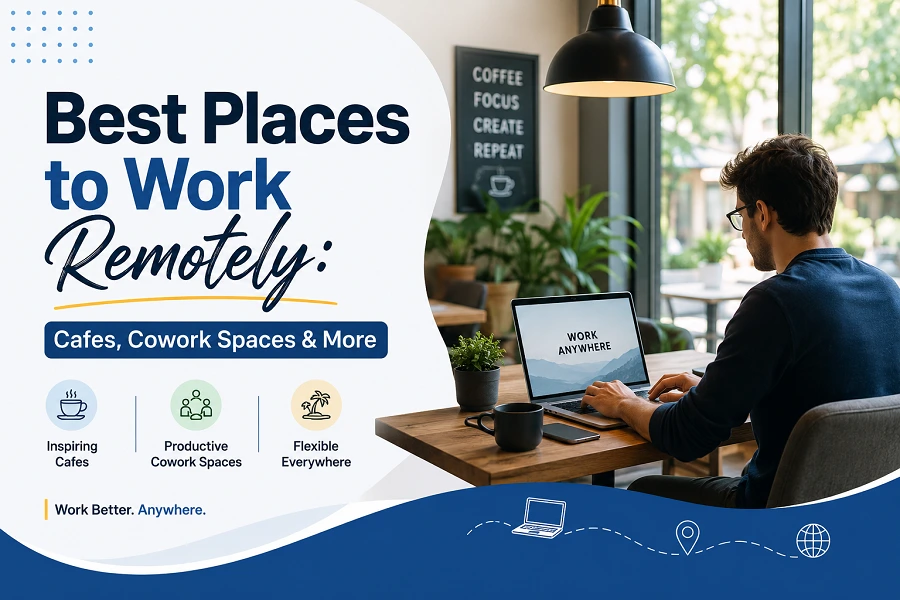
I used to think “remote work” meant working from bed in pajamas. Three years into freelancing, I’ve learned that’s the fastest way to get zero done by 2 p.m. Where you work matters almost as much as how you work — and after bouncing between cafes, coworking spaces, libraries, and even a friend’s garage office for a month, I’ve got opinions.
If you’ve just typed “best place to work remotely near me” into Google, here’s the short version: there’s no single best place — there’s a best place for what you’re doing that day. Deep-focus tasks need a different setup than client calls. Let me break down where each option actually works, and where it falls flat.
Quick Answer: What Fits Your Work Style
- Need silence and zero distractions? → Library or a dedicated coworking space
- Need Wi-Fi, coffee, and a casual vibe? → Café (but pick carefully — more on that below)
- Have back-to-back video calls? → Coworking space with private booths, not a café
- Working odd hours (early morning, late night)? → Home office or 24-hour coworking spot
- Traveling or between cities? → Hotel lobbies, coworking day passes, or serviced apartments with workspaces
Now let’s get into the actual comparison, because “it depends” isn’t very helpful on its own.
1. Cafes: Good for Short Bursts, Not All-Day Grinding
Cafes get romanticized a lot — laptop, latte, ambient chatter, very productive-looking Instagram post. The reality is messier.
I worked out of the same neighborhood café for about four months when I first went freelance. It was great for the first two hours: decent Wi-Fi, good coffee, nobody bothering me. By hour three, I’d usually lost my table to the lunch rush, or the music got loud enough that calls became impossible. Outlets were also a constant hunt — I once sat cross-legged on the floor near a wall socket because every table seat was taken.
What actually works well in cafes:
- Writing, editing, research — tasks that don’t need calls
- Short sessions (2–3 hours max)
- Off-peak hours, usually mid-morning on weekdays
Where cafes fall short:
- Spotty or shared Wi-Fi that slows down when it’s crowded
- No privacy for calls
- Limited outlets, especially in older or trendier spots
- You feel obligated to keep ordering something to justify the table
If you’re going the café route, my honest tip: scout two or three near you and rotate. Staying loyal to one spot means you’re stuck with their bad Wi-Fi days.
2. Coworking Spaces: Best for Consistency and Calls
This is where I ended up settling for most of my “serious work” days. A dedicated coworking space costs money — anywhere from a few thousand rupees a month for a hot desk to significantly more for a private cabin — but you’re paying for reliability, not ambiance.
The biggest difference from a café? Nobody side-eyes you for being on a call for 45 minutes. Most spaces have phone booths or meeting rooms built for exactly that. Wi-Fi is usually business-grade, meaning it doesn’t collapse the moment twenty people join a video call at once.
Good fit if:
- You have regular client meetings or calls
- You want a routine — same desk, same rhythm, less decision fatigue
- You value networking (coworking spaces often have genuinely interesting people around)
Caveats worth knowing:
- Membership costs add up if you’re not using it consistently
- Some spaces get noisy too, especially “startup-y” ones designed for collaboration, not quiet focus
- Day passes are a smart way to test a space before committing monthly
3. Libraries: The Underrated Option
Nobody talks about libraries enough in these lists, honestly. I started using my local public library on days I needed to write something long and complicated — no ambient noise, free Wi-Fi (usually decent), and a kind of enforced silence that cafes just can’t replicate.
The catch: libraries aren’t built for calls, and some have strict no-talking rules. Also, hours are limited — most close by evening, so if you’re a night owl, this isn’t your spot.
Best for: deep work, reading-heavy tasks, budget-conscious remote workers (it’s free)
Not great for: calls, late-night sessions, collaborative work
4. Working From Home: Cheapest, But Requires Discipline
I’m not going to pretend home offices don’t work — they do, for a lot of people. But it took me almost a year to get my setup right: a separate room, a proper chair, and a hard rule about not touching my phone during work blocks.
The upside is obvious — zero commute, zero cost, full control over your environment. The downside is just as real: distractions (laundry, fridge, family, pets), and for some people, a nagging sense of isolation after a few months.
If you’re going this route, invest in one thing early: a real chair. I ignored this for way too long and paid for it with a stiff back that no amount of stretching fixed until I finally bought a proper one.
5. Hotels and Serviced Apartments (For Travelers)
If you’re working remotely while traveling, hotel lobbies and business centers are underrated. Many hotels now offer day-use workspaces even if you’re not staying overnight, and the Wi-Fi tends to be more stable than a random café in an unfamiliar city. Serviced apartments with dedicated desks are another solid option if you’re staying somewhere for a week or more.
How to Actually Pick the Right Spot for You
Instead of hunting for one “perfect” place, try matching the location to the task:
| Task Type | Best Location |
|---|---|
| Deep focus writing/coding | Library, quiet coworking space |
| Client calls or meetings | Coworking space with booths |
| Quick emails, light admin | Café, home |
| Creative brainstorming | Café (change of scenery helps) |
| Long-term daily routine | Coworking space or home office |
A Balanced Take
None of these are perfect. Cafes get crowded, coworking spaces cost money, libraries have odd hours, and home offices demand discipline you might not have yet. The honest answer is that most remote workers I know — myself included — use a mix. Two days a week at a coworking space, one day at home, and the odd café afternoon when I need a change of scenery.
Don’t chase the “ideal” workspace featured in aesthetic productivity videos. Chase the one that gets your actual work done without you fighting your environment the whole day.
Frequently Asked Questions
1. What is the best place to work remotely near me?
It depends on your task. For calls and meetings, a coworking space works best. For quiet, focused work, a library or quiet café outside peak hours is ideal. Search “coworking spaces near me” or “quiet cafes near me” to compare local options.
2. Are cafes good for remote work all day?
Not usually. Cafes work well for 2–3 hour sessions but tend to get crowded, noisy, and Wi-Fi can slow down during peak hours.
3. How much do coworking spaces typically cost?
Prices vary widely by city and space type — hot desks are usually cheaper than private cabins. Many spaces offer day passes, which are a good way to test before committing to a monthly plan.
4. Is working from a library actually productive?
Yes, especially for deep-focus tasks like writing or research. Libraries are quiet and usually have free Wi-Fi, though most aren’t suited for calls and have limited hours.
5. What should I look for in a good remote work café?
Reliable Wi-Fi, enough outlets, a table that isn’t cramped, and off-peak hours to avoid crowding. It also helps to have a backup café nearby.
6. Do coworking spaces allow day passes?
Most do. Day passes let you try a space before signing up for a monthly membership, which is useful if you’re unsure about the vibe or crowd.
7. Is it better to work from home or a coworking space?
It depends on your discipline and need for social interaction. Home is cheaper and commute-free but requires self-discipline; coworking spaces offer structure and networking but cost money.
8. Can I take client calls from a café?
It’s possible but not ideal — background noise and lack of privacy are common issues. A coworking space with a phone booth or a quiet corner works better.
9. What’s the best remote work setup for frequent travelers?
Hotel business centers, serviced apartments with desks, and coworking spaces with day passes in major cities tend to work best for travelers.
10. How do I stay productive working from home?
Set a dedicated workspace separate from your bedroom or living area, invest in a proper chair, and set clear work-hour boundaries to avoid distractions.
11. Are coworking spaces worth it for freelancers?
For freelancers who need routine, networking, or a professional space for client calls, yes. For those who work well independently and rarely take calls, it might be an unnecessary expense.
12. What time of day is best to work from a café?
Mid-morning on weekdays, typically after the breakfast rush and before lunch, tends to be quieter with better table availability.
13. Do libraries have Wi-Fi for remote work?
Most public libraries offer free Wi-Fi, though speed and reliability vary by location. It’s worth checking reviews or calling ahead if you plan to rely on it for calls.
14. What’s the biggest downside of remote work from cafes?
Inconsistent Wi-Fi and lack of privacy for calls are the two most common complaints, along with limited outlet access during busy hours.
15. Should I invest in a home office setup or just use coworking spaces?
If you work remotely long-term, a basic home office setup (desk, chair, decent internet) is worth the investment even if you also use coworking spaces occasionally — it gives you a reliable fallback option.