

I’ve slept on both. For almost four years, it was a memory foam mattress that hugged me like a warm sandbag every night. Then my back started complaining — not agony, just that dull stiffness you get from sleeping too “sunk in.” Switching to a hybrid changed things more than I expected, and that’s really why I wanted to write this out properly instead of just recycling what every other mattress site says.
Here’s the short answer, if you’re in a hurry: memory foam is better if you sleep on your side, get cold easily, and want that classic “sinking into a cloud” feel. A hybrid is better if you sleep hot, switch positions a lot, or share the bed with someone whose movements wake you up. That’s the one-line version. Now let’s actually dig into why.
What’s the Real Difference Between the Two?
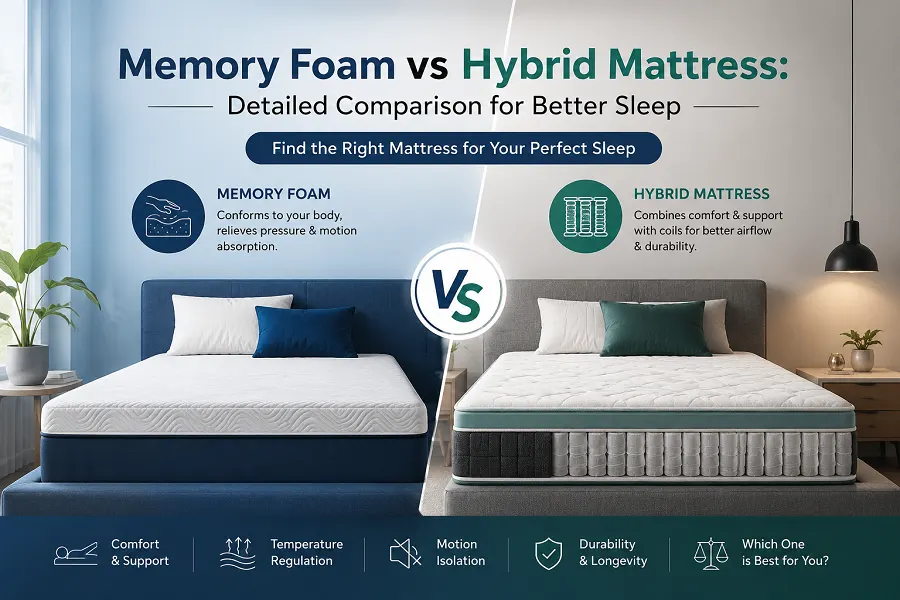
A memory foam mattress is built almost entirely from foam layers — usually a base support foam topped with viscoelastic memory foam that responds to body heat and pressure. It’s the mattress that leaves a slow-fading imprint when you press your hand into it.
A hybrid mattress mixes two worlds: a layer of pocketed coils (like a traditional innerspring) for support and bounce, topped with a few inches of foam — sometimes memory foam, sometimes latex — for comfort. Think of it as a compromise mattress built for people who like some of the foam feel but don’t want to lose the coil support and airflow underneath.
That’s really the whole story in one paragraph. Everything else — cost, cooling, motion transfer, durability — flows from that basic construction difference.
Memory Foam vs Hybrid Mattress: Comparison Table
If you just want to make a table comparing memory foam vs hybrid mattresses side by side, here it is:
| Feature | Memory Foam Mattress | Hybrid Mattress |
|---|---|---|
| Construction | All-foam layers | Coils + foam/latex comfort layer |
| Feel | Slow sink, body-hugging | Bouncier, more “on top of” feel |
| Motion isolation | Excellent — great for couples | Good, but coils transfer more movement than pure foam |
| Temperature | Tends to sleep warmer | Sleeps cooler due to airflow through coils |
| Support for back/joint pain | Very good for pressure relief | Very good, plus better edge and spinal support |
| Average price range | ₹15,000 – ₹45,000 | ₹22,000 – ₹65,000 |
| Durability | 7–10 years typically | 6–8 years typically (coils wear faster) |
| Best for | Side sleepers, solo sleepers, cold sleepers | Combination sleepers, couples, hot sleepers |
| Edge support | Weaker | Stronger |
| Weight/portability | Lighter, easier to move | Heavier, harder to move |
This is the chart most shoppers are actually looking for when they search for a memory foam vs hybrid mattress comparison — it covers the practical stuff that decides whether you’ll actually be happy with the purchase six months in, not just on day one.
Comfort and Feel: The Part Numbers Can’t Explain
Numbers on a spec sheet don’t tell you what it feels like to lie down at 11 PM after a long day. Memory foam gives you that slow, cradling sink — your hips and shoulders settle into the mattress rather than resting on top of it. Good for pressure points, but if you toss and turn, you’ll notice it takes a second to “escape” the mattress when you shift positions. Some people love that; others describe it as feeling stuck.
Hybrid mattresses feel more responsive. You sit or lie down and it pushes back a bit more, kind of like a firmer cushion instead of a bean bag. Getting in and out of bed is easier, and for anyone who changes sleeping position through the night, the coils help you move without that “digging yourself out” sensation.
Temperature: Why Hybrid Usually Wins Here
This one comes down to basic physics. Dense foam traps heat because there’s nowhere for warm air to escape. Hybrid mattresses have actual air pockets between coils, so heat moves through instead of building up.
If you already run hot at night, or you live somewhere without reliable AC through the humid months, this single factor can matter more than anything else on this list. I’ve had readers tell me their memory foam mattress was fine in winter but genuinely uncomfortable by June — that tracks with what the material does.
Some memory foam brands now add gel infusions or open-cell foam to fight this, and it does help somewhat. But it rarely matches the natural airflow a coil layer gives you.
What About Cost and Where to Buy?
Memory foam mattresses are usually cheaper to manufacture, which is part of why you’ll find budget options starting lower than hybrids. Hybrids cost more because they need both a coil unit and a foam comfort layer — more materials, more manufacturing steps.
If you’re comparing prices locally, most furniture stores and mattress showrooms stock a mix of both — worth testing in person if there’s one near you, since firmness preference is genuinely personal and no online description substitutes for actually lying down on it for ten minutes. Online-only brands (the “bed in a box” type) often give you a 100-night trial, which is honestly the smarter way to test this at home rather than guessing based on a showroom nap.
A quick warning: don’t just buy whatever mattress forums are hyping up. If you check a mattress subreddit, you’ll see wildly different opinions from people with different body types, sleep positions, and budgets — what worked for a 60kg side sleeper won’t necessarily work for a 90kg back sleeper. Use those discussions for general impressions, not as gospel.
Durability: Which One Lasts Longer?
Good memory foam, especially higher-density foam, tends to hold its shape longer than the coil layer in a hybrid. Coils can lose tension over years of use, especially with cheaper hybrid models that cut corners on coil gauge. That said, a well-made hybrid from a reputable brand will still comfortably last 6-8 years with normal use.
One practical tip: check the density of the foam (in kg/m³) before buying a memory foam mattress. Anything below 32 kg/m³ tends to break down faster and develop those annoying permanent body indentations within 2-3 years.
Who Should Choose What?
Go with memory foam if:
- You sleep mostly on your side and need pressure relief on shoulders/hips
- You sleep alone or your partner doesn’t move much at night
- You tend to feel cold at night
- Budget is a bigger factor than premium features
Go with hybrid if:
- You sleep hot or live somewhere humid
- You switch between back, side, and stomach through the night
- You share the bed and want responsive support without feeling like you’re falling into a hole
- You’re willing to pay more for better edge support and longer-term bounce
Neither one is objectively “better” — that’s the part a lot of comparison articles skip because it doesn’t sound decisive. But mattress shopping isn’t really about finding the winner; it’s about finding what matches your body and your sleep habits.
A Quick Reality Check
Don’t expect any mattress — foam, hybrid, or otherwise — to fix chronic back pain on its own. It can help with comfort and support, but if you’re dealing with ongoing pain, that’s a conversation for a doctor or physiotherapist, not a mattress review. Also, “cooling gel” marketing on foam mattresses helps a little, but it won’t make foam sleep as cool as a hybrid — manage your expectations there.
Internal Linking Suggestions
- Best Mattress for Back Pain: A Buyer’s Guide
- How to Choose the Right Mattress Firmness for Your Body Type
- Innerspring vs Memory Foam vs Hybrid: Which Mattress Type Fits Your Budget?
Frequently Asked Questions
1. Is a hybrid mattress better than memory foam for back pain? It depends on the person, but hybrids often work better for back sleepers because the coil layer keeps the spine more aligned, while memory foam can let hips sink too deep for some body types.
2. Which mattress sleeps cooler — memory foam or hybrid? Hybrid mattresses sleep cooler because the coil layer allows airflow. Memory foam traps body heat, though gel-infused versions reduce this somewhat.
3. Do hybrid mattresses cost more than memory foam? Generally yes. Hybrids use both coils and foam layers, so manufacturing costs — and retail prices — run higher on average.
4. How long does a memory foam mattress last? A good-quality memory foam mattress (32 kg/m³ density or higher) typically lasts 7-10 years with proper care.
5. Is memory foam good for side sleepers? Yes, it’s often the top choice for side sleepers because it cushions the shoulders and hips, reducing pressure point pain.
6. Do hybrid mattresses transfer more motion than memory foam? Slightly, yes. Memory foam absorbs movement almost completely, while hybrids transfer a bit more due to the coil layer, though pocketed coils minimize this compared to old-style innerspring beds.
7. Can I try a mattress before buying online? Most online mattress brands offer a trial period (often 100 nights), letting you test it at home and return it if it doesn’t suit you.
8. Which mattress is better for couples? Hybrid mattresses are usually recommended for couples because of better edge support and easier movement, though memory foam wins on motion isolation if one partner tosses and turns a lot.
9. What’s the average price difference between memory foam and hybrid mattresses? Memory foam mattresses typically start lower, while hybrids usually cost 20-40% more due to the added coil layer and materials.
10. Do memory foam mattresses smell when new? Yes, this is called off-gassing. It’s the foam releasing manufacturing chemicals and usually fades within a few days to two weeks with proper airing.
11. Which is better for hot climates — memory foam or hybrid? Hybrid mattresses are generally better for hot or humid climates because of the airflow through the coil layer.
12. Is a firmer mattress always better for back support? Not necessarily. Support depends more on proper spinal alignment than pure firmness — a mattress that’s too firm can create pressure points just like one that’s too soft.
13. How often should I replace my mattress? Most mattresses, foam or hybrid, should be replaced every 7-10 years, or sooner if you notice sagging, lumps, or waking up with new aches.
14. Are hybrid mattresses heavier than memory foam mattresses? Yes, because of the metal coil layer, hybrids are noticeably heavier and harder to move or flip compared to all-foam mattresses.
15. Can a mattress alone fix chronic back pain? No. A supportive mattress can improve comfort, but chronic pain needs proper medical evaluation — don’t rely on a mattress purchase as a substitute for professional advice.