
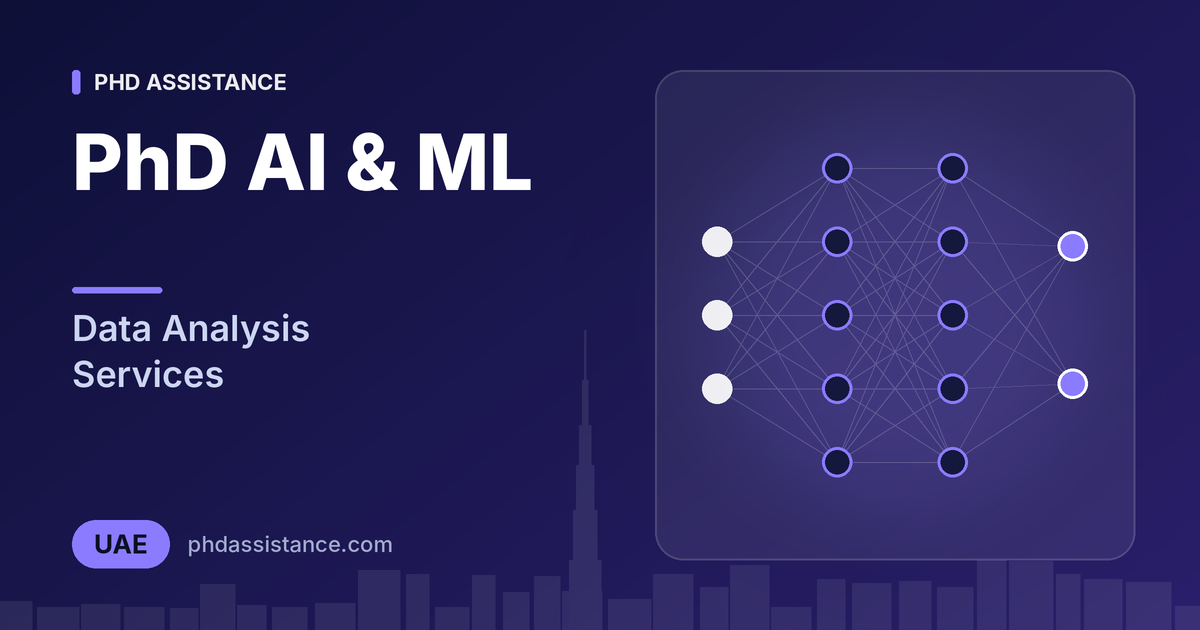
The UAE has made artificial intelligence a national priority, and PhD students in Dubai, Abu Dhabi, and Sharjah are building machine learning models for healthcare, smart cities, finance, and energy. But a working model is not the same as a defensible thesis chapter. PhD Assistance provides PhD AI & ML Data analysis Services UAE to help scholars with messy data, weak evaluation, and unexplained models. This blog covers three common problems in AI and ML research and shows how expert support can solve each one.
Problem 1: Messy, Imbalanced, or Insufficient Data
Before any algorithm runs, the dataset decides the quality of your results. Students commonly face missing values, inconsistent formats, duplicate records, and classes that are heavily imbalanced, such as a medical dataset with very few positive cases. Training on such data gives high accuracy that hides poor real performance.
The solution starts with exploratory data analysis. Profile every variable, visualise distributions, and document what you remove or fix. Handle missing values with a method that suits the pattern, such as median imputation, k-nearest neighbours imputation, or model-based imputation. For imbalanced classes, apply resampling techniques like SMOTE, class weights, or cost-sensitive learning, and always apply them only to the training set to avoid data leakage. If your data are too limited, consider data augmentation or transfer learning. Writing each preparation step clearly in your methodology lets examiners reproduce your work.
Problem 2: Weak Model Selection and Evaluation
Many students pick a popular algorithm, report one accuracy score, and stop there. Examiners will ask why that model was chosen, how it was tuned, and whether the result would hold on new data. A single train-test split can easily mislead you.
A stronger approach is to compare several suitable models, for example logistic regression, random forest, gradient boosting, support vector machines, and a neural network, against a simple baseline. Use k-fold cross-validation and tune hyperparameters with grid search or Bayesian optimisation. Choose metrics that match your problem: precision, recall, F1-score, and ROC-AUC for classification; RMSE and MAE for regression. Then test whether differences between models are statistically meaningful using paired tests rather than relying on small gaps in scores. Python libraries such as scikit-learn, TensorFlow, and PyTorch support this workflow well, and an expert reviewer can spot design flaws before your committee does. Through PhD AI & ML Data analysis Services UAE, PhD Assistance helps scholars prepare datasets, compare models, and validate results before submission.
Problem 3: Black-Box Models That Cannot Be Explained
Deep learning and ensemble models often give strong results, yet students find it hard to explain how predictions are made. This matters most in healthcare, finance, and government projects, where trust and accountability are essential.
Build explainability into your analysis from the start. Use feature importance plots, SHAP values, and LIME to show which inputs drive each prediction. Report error analysis, not just averages, by examining where the model fails and why. Discuss limitations honestly, including bias in the training data and the risk of overfitting. Also record your code, library versions, and random seeds so your experiments can be repeated. This level of transparency strengthens your discussion chapter and answers common viva questions about reliability and ethics.
Conclusion
AI and ML research becomes far easier when data preparation, model evaluation, and explainability are handled in a structured way. These three steps turn a promising experiment into a thesis that stands up to scrutiny. PhD Assistance provides PhD AI & ML Data analysis Services UAE for scholars across the Emirates, covering dataset cleaning, model building in Python, performance evaluation, statistical validation, and clear reporting. Share your research topic and dataset with PhD Assistance today to get expert guidance that fits your timeline and university requirements.