

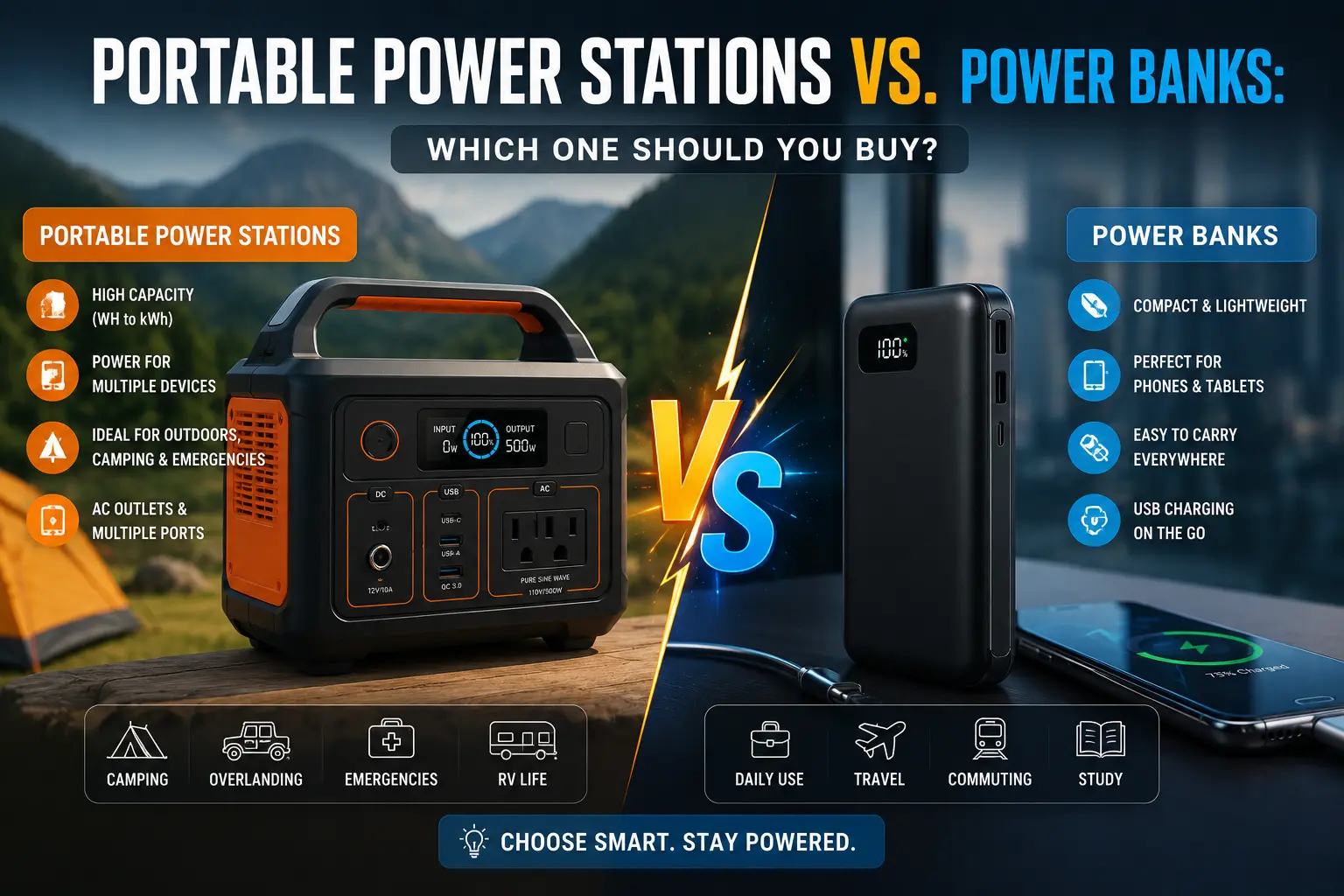
Choosing between a portable power station and a power bank depends entirely on your specific energy requirements. While both devices store electricity for later use, their internal architecture, output capabilities, and intended use cases differ significantly. Understanding these differences ensures you invest in the right gear for your lifestyle.
Core Technical Differences
A power bank is essentially a portable battery designed for small-scale electronics. It typically relies on lithium-polymer or lithium-ion cells, prioritizing slim form factors and portability. These devices generally output power via USB ports, making them ideal for charging smartphones, tablets, and wireless earbuds.
In contrast, portable power stations function as high-capacity energy hubs. They utilize advanced Battery Management Systems (BMS) to regulate power flow for both low-voltage USB devices and high-voltage AC appliances. With integrated inverters, they can convert DC battery power into pure sine wave AC electricity, allowing you to plug in household electronics like blenders, laptops, or CPAP machines.
-
Weight and Bulk: Power banks fit in your pocket; power stations often require a handle or a dedicated carrying bag.
-
Output Versatility: Power banks focus on USB-C and USB-A; power stations include AC wall outlets, DC car ports, and sometimes wireless charging pads.
-
Charging Speed: Power stations often support high-wattage solar panel inputs, whereas power banks are generally restricted to standard wall charging.
-
Longevity: Power stations use robust chemistry designed for thousands of cycles, often making them suitable for long-term home backup.
How to Determine Your Power Needs
Selecting the right device requires a clear audit of the equipment you plan to power. If your goal is simply to prevent your phone from dying during a commute or a short hike, a compact power bank is the most efficient choice. However, if you are planning an off-grid excursion or preparing for emergency power outages, the sheer volume of a power station becomes necessary.
-
Calculate Total Watt-Hours: Check the labels on your devices to see how many watts they consume, then estimate how long you need them to run.
-
Identify Output Requirements: If you need to power a device with a standard three-prong wall plug, a power bank will not suffice; you need the AC inverter found in a power station.
-
Consider Weight Constraints: If you are backpacking, every ounce matters, favoring lightweight power banks. If you are car camping or RVing, the weight of a power station is negligible.
-
Evaluate Input Versatility: If you plan on staying off-grid for days, look for a power station that accepts solar input to keep the battery topped up during the day.
Longevity and Safety Features
Safety is paramount when dealing with lithium-based batteries. Modern power stations are engineered with sophisticated thermal management and short-circuit protection, which is critical when handling the higher voltages associated with AC outlets. They are designed to manage heat dissipation during heavy use, whereas most power banks are intended for lower-drain, intermittent usage.
Battery health is also dictated by the cycle life. High-end power stations often utilize Lithium Iron Phosphate (LiFePO4) chemistry, which offers significant durability compared to the lithium-ion batteries found in many standard power banks. Investing in a unit that balances your capacity needs with high-cycle-life chemistry will provide better long-term value.
Conclusion
The decision between these two power solutions comes down to scale. Use a power bank for your mobile, everyday charging needs where portability is the priority. Reserve the portable power station for situations demanding high wattage, long-duration power, or the ability to run standard AC appliances. By matching your device choice to your specific power consumption, you ensure that you are never left without energy when you need it most.
Frequently Asked Questions
Can I take a portable power station on a plane? Most airlines have strict limits on lithium battery capacity, usually capping at 100Wh. Most portable power stations exceed this limit and are generally prohibited in carry-on or checked luggage.
Do power banks lose charge when not in use? Yes, all lithium batteries experience self-discharge over time. It is best to check your power bank every few months and top it off if it has been sitting idle.
Can I use a solar panel with any power bank? Only specific power banks designed with built-in solar controllers can be charged directly by panels. Most power banks require a wall outlet to recharge.
Will a power station run a refrigerator? It depends on the surge and running wattage of the fridge. While many mid-sized power stations can run a compact fridge for several hours, they may struggle with full-sized residential units.
How do I know which capacity I need? Estimate the total watt-hours of all devices you intend to power and add a 20% buffer for energy loss during the conversion process to ensure you have enough headroom.