
Enterprise technology is changing at a remarkable pace. Businesses are no longer looking for isolated software tools that solve one small problem. They want connected, scalable, intelligent solutions that can improve operations, support better decisions, and remain useful as their organizations grow. This is where Droven.io enterprise tech innovation becomes an interesting topic for businesses exploring modern digital transformation.
Rather than treating technology as a collection of disconnected systems, the broader enterprise innovation landscape focuses on integration, automation, data intelligence, cybersecurity, and scalable infrastructure. For organizations under pressure to modernize, these capabilities can make the difference between simply adopting new technology and creating a genuinely more efficient operation.
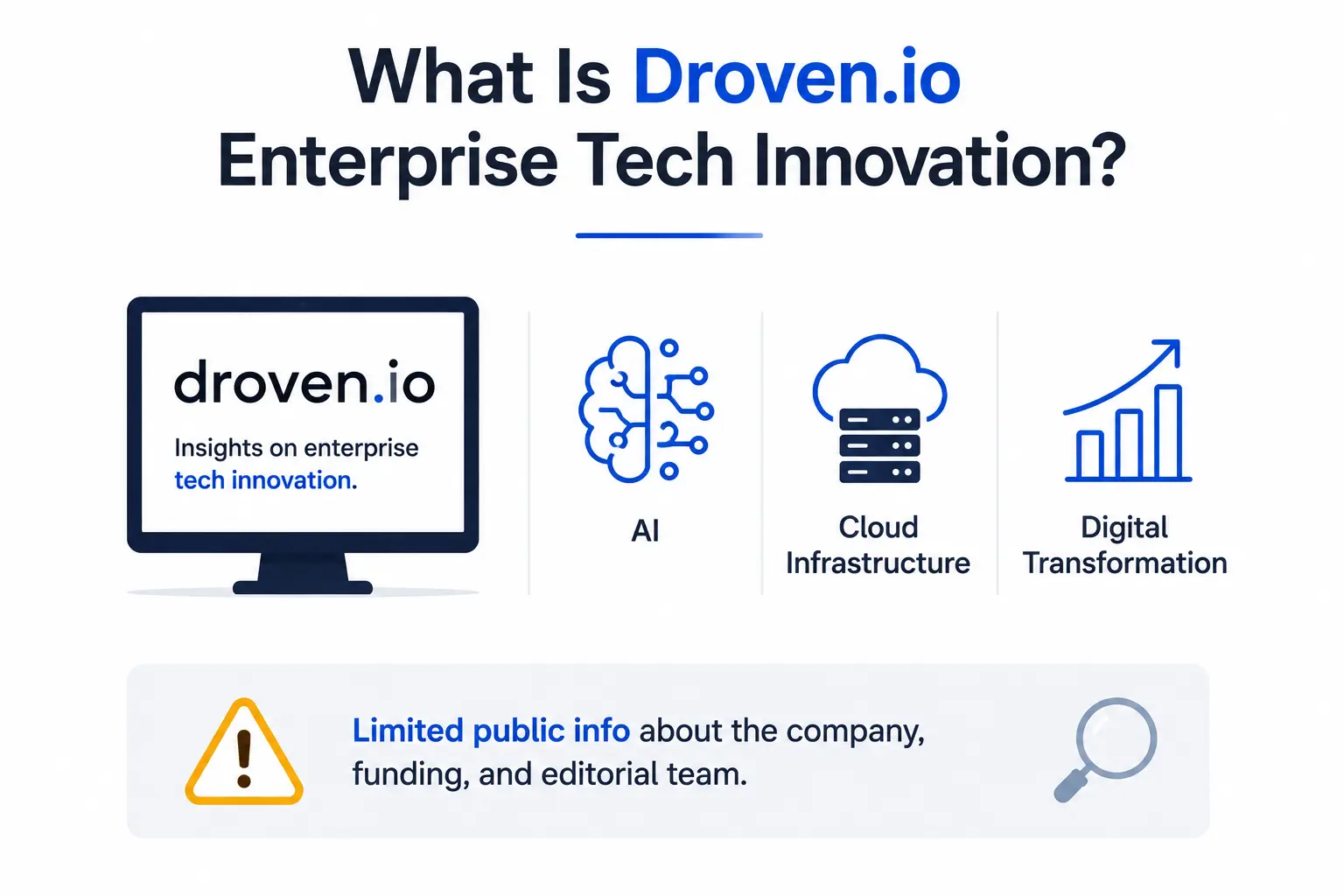
What Is Droven.io Enterprise Tech Innovation?
The phrase refers broadly to the role of Droven.io in the enterprise technology and innovation space. The concept centers on using modern digital capabilities to help organizations address complex operational and technological requirements.
Enterprise innovation is not simply about purchasing the newest software. It involves identifying inefficient processes, understanding where technology can create measurable value, and implementing solutions that work reliably across departments.
For example, a growing company may have separate systems for customer management, finance, inventory, communication, and analytics. When those systems cannot communicate effectively, employees spend valuable time transferring information manually. A modern technology strategy aims to reduce that friction.
Why Enterprise Technology Needs to Evolve
Traditional business systems were often designed around specific departments. That approach worked when organizations operated with relatively predictable workflows. Today’s companies, however, generate enormous volumes of data and frequently operate across multiple locations and digital channels.
Customers expect faster service. Employees expect accessible tools. Managers want real-time information. Meanwhile, security requirements continue to become more demanding.
This creates a difficult balancing act: businesses need innovation, but they cannot afford unnecessary complexity.
A successful enterprise technology strategy therefore needs to combine innovation with practicality. New capabilities should solve genuine business problems rather than becoming technology for technology’s sake.
Key Areas of Modern Technology Innovation
Several areas are particularly important when discussing enterprise digital transformation.
Intelligent Automation
Automation can reduce repetitive administrative work and allow employees to concentrate on tasks requiring judgment and creativity. Workflow automation, intelligent document processing, and automated reporting can all contribute to operational efficiency.
Data-Driven Decision Making
Data becomes significantly more valuable when organizations can turn it into actionable information. Modern analytics platforms can help companies identify trends, monitor performance, and discover potential problems earlier.
Cloud-Based Infrastructure
Cloud technology provides organizations with flexible computing resources and easier access to applications and data. It can also support remote teams and make scaling infrastructure less dependent on physical hardware.
Cybersecurity and Risk Management
Innovation without security creates unnecessary exposure. Enterprise technology initiatives increasingly need identity management, access controls, monitoring, encryption, and appropriate data governance.
System Integration
Integration is often overlooked, yet it can have an enormous effect on productivity. Connecting business applications allows information to move between systems with less manual intervention.
How the Approach Differs From Traditional IT
Traditional IT often concentrates on maintaining existing infrastructure. Enterprise innovation takes a broader perspective by asking how technology can improve the entire business.
| Area | Traditional IT Approach | Modern Enterprise Innovation |
|---|---|---|
| Primary focus | Infrastructure maintenance | Business transformation |
| Data | Stored across systems | Connected and analyzed |
| Automation | Limited | Embedded into workflows |
| Scalability | Often hardware-dependent | Designed for flexible growth |
| Decision making | Periodic reporting | Data-driven and continuous |
| Security | Mainly defensive | Integrated throughout technology |
The difference is important. A business can have reliable servers and applications while still operating inefficiently. Innovation looks beyond system availability and examines whether technology is actually improving business performance.
Enterprise Technology in Real-World Business Operations
Imagine a regional retailer expanding from five stores to twenty.
Initially, employees can manage inventory manually because product volumes are manageable. As the company expands, that same process becomes increasingly difficult. Stock information becomes inconsistent, purchasing decisions take longer, and managers lack a unified view of performance.
A connected enterprise technology environment could integrate inventory, sales, purchasing, customer information, and analytics. Instead of waiting for separate reports, decision-makers could work with more centralized information.
The value is not simply having newer software. The real benefit comes from removing unnecessary friction between people, processes, and information.
The Role of Scalability
Scalability should be considered from the beginning of any enterprise technology project.
A solution that performs well for 50 employees may become difficult to manage when an organization reaches 500. Likewise, a system designed without future integrations can create expensive technical limitations later.
Scalable architecture allows organizations to expand capabilities without rebuilding their entire technology environment. This is especially important for companies experiencing rapid growth, acquisitions, international expansion, or increasing digital demand.
Why Integration Matters So Much
One of the biggest challenges facing enterprises is technology fragmentation.
A company might use excellent individual applications but still experience poor productivity because those applications operate independently. Employees may have to export spreadsheets, copy information between platforms, or repeatedly enter the same customer details.
Integration can reduce these problems.
When systems communicate effectively, organizations can create smoother workflows and establish a more consistent source of business information. That can improve both employee productivity and customer experiences.
Innovation Should Have a Measurable Purpose
Technology investment should ultimately connect to business outcomes.
Before implementing a new solution, organizations should ask:
- What problem are we solving?
- How much time or money could it save?
- What measurable improvement should we expect?
- Can employees adopt it without excessive disruption?
- Will the solution remain useful as the organization grows?
These questions prevent innovation projects from becoming expensive experiments.
In my experience, the most useful technology improvements are often not the flashiest ones; they are the changes that quietly remove bottlenecks employees deal with every day.
Challenges Businesses Should Consider
Enterprise innovation comes with challenges. Integration projects can be technically complicated, legacy systems may not support modern architectures, and employees may resist unfamiliar workflows.
Data quality is another major concern. Advanced analytics cannot produce dependable insights when the underlying information is incomplete, duplicated, or inconsistent.
Cost also matters. Businesses need to evaluate implementation expenses, maintenance requirements, training, security, and long-term scalability rather than focusing only on the initial purchase price.
Building a More Future-Ready Technology Environment
A future-ready enterprise does not necessarily need to adopt every emerging technology. Instead, it should develop the ability to evaluate and implement useful technologies efficiently.
That means establishing strong data practices, modernizing outdated infrastructure where necessary, improving integration, investing in cybersecurity, and creating a culture where employees can adapt to technological change.
The strongest technology strategy is usually evolutionary rather than revolutionary. Organizations can begin with high-impact processes, measure results, learn from implementation, and gradually expand successful solutions.
What Makes Enterprise Innovation Valuable?
The real value of enterprise innovation lies in the connection between technology and business strategy.
When technology reduces repetitive work, improves information flow, strengthens security, and gives leaders clearer visibility, its impact extends far beyond the IT department.
This is the broader significance of Droven.io enterprise tech innovation: the conversation is not merely about adopting digital tools. It is about considering how technology can become a practical engine for operational improvement and sustainable growth.
Also Read: Smart DevicesG15Tool Com Gadgets: Latest Tech Tools and
Conclusion
Enterprise technology is moving toward environments that are more connected, intelligent, scalable, and automated. Businesses that approach innovation strategically can improve productivity while creating stronger foundations for future growth.
Droven.io enterprise tech innovation represents a useful topic within this broader transformation because it highlights the growing importance of modern enterprise technology. The strongest results come when businesses focus on genuine operational problems, integrate systems thoughtfully, protect their data, and choose technology that can evolve alongside their needs.
Ultimately, successful innovation is not measured by how much technology a company owns. It is measured by how effectively that technology helps people work, make decisions, serve customers, and grow.
FAQs
What is Droven.io enterprise tech innovation?
It refers to the broader enterprise technology innovation concept associated with Droven.io, including modern approaches to digital transformation, automation, integration, data, scalability, and business technology.
Why is enterprise technology innovation important?
It can help organizations improve operational efficiency, connect fragmented systems, make better use of data, strengthen security, and prepare their infrastructure for future growth.
How does automation help enterprises?
Automation can reduce repetitive manual tasks, improve workflow consistency, reduce errors, and allow employees to spend more time on higher-value responsibilities.
Why is system integration important for businesses?
Integration allows different applications and departments to exchange information more efficiently. It can reduce duplicate data entry and create smoother business workflows.
Is cloud technology important for enterprise innovation?
Cloud infrastructure can provide flexible resources, support distributed teams, and make it easier for organizations to scale technology as business requirements change.
What should businesses consider before adopting new technology?
Organizations should evaluate business objectives, implementation costs, scalability, security, employee adoption, integration requirements, and measurable expected outcomes.