

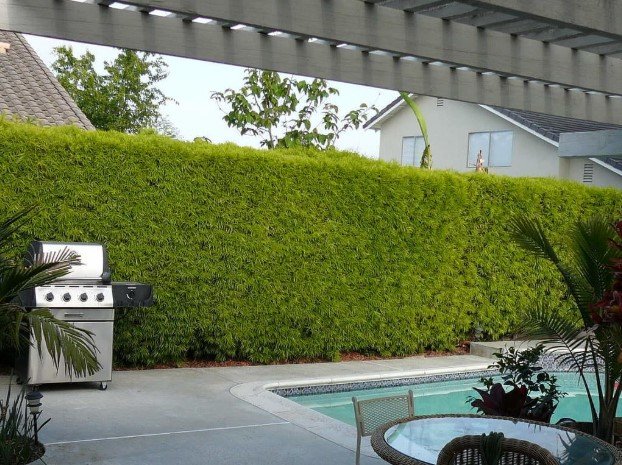
Creating a natural privacy barrier requires plants that provide consistent foliage, adapt to local growing conditions, and respond well to regular maintenance. Evergreen hedges are particularly useful for establishing landscape boundaries without relying entirely on artificial fencing. Among the available options, Podocarpus hedge plants are valued for their soft, feathery foliage and upright growth habit. Podocarpus gracilior, commonly known as African fern pine, can be maintained as a formal hedge, privacy screen, or windbreak. Understanding its planting requirements, spacing, watering needs, and pruning techniques helps homeowners establish healthy vegetation while maintaining an attractive and functional landscape throughout the different seasons.
Understanding the Characteristics of Podocarpus Gracilior
Podocarpus gracilior, also classified as Afrocarpus gracilior, is an evergreen conifer native to eastern Africa. It produces slender green leaves that contribute to its soft, fernlike appearance.
Although naturally capable of growing into a large tree, it responds well to pruning and can be maintained as a narrower hedge. Its evergreen foliage provides visual coverage throughout the year, making it suitable for residential gardens, commercial landscapes, and property boundaries.
Once established, the plant demonstrates tolerance to heat, drought, and urban growing conditions.
Selecting a Suitable Planting Location
Choosing an appropriate location for Podocarpus hedge plants helps support healthy root development and consistent foliage growth.
Several environmental factors should be considered:
- Sunlight: Full sun to partial shade provides suitable growing conditions.
- Soil drainage: Well-draining soil helps prevent excessive moisture around the roots.
- Available space: Sufficient room accommodates root development and future foliage growth.
- Climate: Mild climates with limited exposure to severe freezing temperatures are generally preferable.
Assessing these conditions before planting helps reduce environmental stress and supports long-term establishment.
Proper Planting Techniques and Hedge Spacing
Dig a planting hole approximately twice the width of the root ball. Position the plant at the same depth at which it was growing in its nursery container.
Backfill the hole gently and water thoroughly to settle the surrounding soil. Maintain consistent spacing between individual plants according to the desired hedge density and anticipated growth.
Larger nursery specimens can provide greater initial screening height, while smaller plants require additional growing time before establishing substantial coverage.
Watering and Soil Moisture Requirements
Newly planted hedges require regular watering during their establishment period. Consistent soil moisture supports root development, particularly during warm weather.
Established Podocarpus hedge plants demonstrate greater drought tolerance, although supplemental watering may remain necessary during prolonged dry periods.
Water deeply enough to reach the root zone rather than repeatedly moistening only the soil surface. Adjust watering frequency according to seasonal temperatures, rainfall, and drainage conditions.
Applying organic mulch around the planting area can help conserve moisture, regulate soil temperature, and suppress competing weeds. Keep mulch away from the trunk to prevent excessive moisture accumulation.
Pruning Techniques for a Dense and Uniform Hedge
Regular pruning helps maintain the desired hedge height, width, and overall shape. Light trimming encourages lateral branching, which contributes to denser foliage coverage.
When shaping a formal hedge, maintain a slightly wider base than the upper portion. This arrangement allows sunlight to reach lower branches and helps reduce uneven foliage development.
Remove damaged or dead branches when necessary and use clean, sharp pruning tools. Periodic maintenance also prevents excessive growth from extending into walkways, driveways, and neighboring planting areas.
Landscape Applications Beyond Property Boundaries
Fern pine hedges serve several functional and decorative purposes within landscape designs.
Their upright growth habit makes them suitable for screening patios, defining garden sections, and creating evergreen backgrounds for ornamental plants.
They can also function as windbreaks and provide visual separation between outdoor activity areas. However, screening effectiveness depends on planting density, foliage development, and ongoing maintenance.
Conclusion
Establishing a healthy evergreen hedge requires appropriate planting conditions, consistent watering, suitable spacing, and regular pruning. Nursery listings such as Plant Clearance provide information about available specimen sizes and growing requirements. Understanding the natural growth characteristics of fern pine helps homeowners develop effective privacy screens while maintaining balanced foliage and healthy root systems throughout the hedge’s lifespan.